


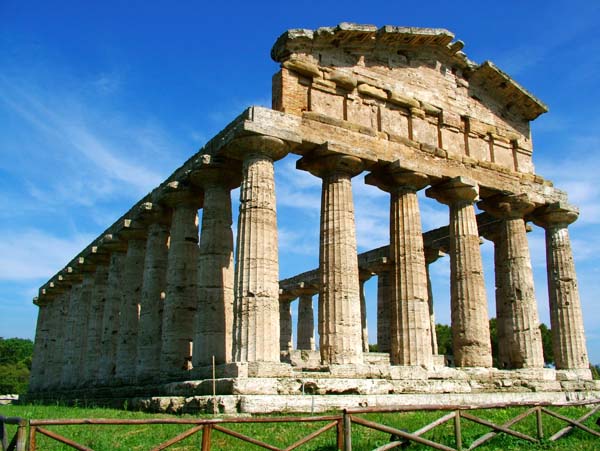
The Temple of Athena stands in the northern part of ancient Poseidonia, separate from the two great temples of the southern sanctuary.
Built around 500 BC, it is the second oldest of the three major Greek temples still standing at Paestum: later than the Temple of Hera, known as the Basilica, and earlier than the great temple traditionally called the Temple of Neptune.
Its architecture is particularly interesting because it combines elements of the Doric and Ionic orders, reflecting the transition from the Archaic period towards architectural forms that would become characteristic of Classical Greek architecture.
Why was it called the Temple of Ceres?
For many years the monument was also known as the Temple of Ceres, a name given to it before archaeological research provided a clearer understanding of the sanctuary and its cult.
The discovery of numerous votive offerings associated with Athena eventually led archaeologists to identify the temple as a sanctuary dedicated to the goddess.
Today it is therefore generally known as the Temple of Athena, the name also used for the monument by the Archaeological Parks of Paestum and Velia.
Architecture of the Temple of Athena
The temple has a rectangular plan surrounded by a colonnade of six Doric columns on the short sides and thirteen on the long sides.
It stands on a base of three steps and occupies a slightly elevated position within the northern sanctuary, giving the building a particularly prominent appearance.
Above the columns ran the entablature, composed of a plain architrave and a Doric frieze with alternating triglyphs and metopes.
Important parts of the pediments and upper structure are still preserved, making it possible to appreciate the proportions and original monumentality of the building.
The temple was also richly decorated. Architectural elements were originally covered with stucco and painted in vivid colours, reminding us that ancient Greek temples looked very different from the bare stone monuments visible today.
Doric and Ionic architecture in the same temple
One of the most distinctive features of the Temple of Athena is the combination of Doric and Ionic architectural elements.
While the external colonnade is Doric, the pronaos at the entrance to the cella was preceded by columns with Ionic capitals.
This combination of the two architectural orders was an innovative solution for its period and is one of the most interesting aspects of the monument.
The Temple of Athena therefore occupies an important position in the development of Greek architecture between the end of the Archaic period and the beginning of the Classical age.
The northern sanctuary of Poseidonia
The temple was not an isolated monument. It stood at the centre of the northern sanctuary of ancient Poseidonia, one of the principal sacred areas of the Greek city.
The sanctuary occupied one of the highest points within the urban area. Before the monumental temple visible today was constructed, religious activities had already taken place here.
Archaeological investigations have identified the remains of an earlier sacred building dating to around 580 BC, which was later destroyed by fire.
The construction of the great Temple of Athena around 500 BC therefore represented a new monumental phase in a sanctuary that had already played an important role in the religious life of Poseidonia.
The cult of Athena
Numerous votive objects discovered in the sanctuary have helped identify Athena, later associated with the Roman goddess Minerva, as the principal deity worshipped here.
Terracotta statuettes depict the goddess as an armed young woman wearing a helmet and carrying weapons.
Weapons were also offered as votive gifts. Archaeologists have discovered helmets, shields, arrowheads and spearheads, as well as miniature weapons that probably had a specific ritual significance.
The sanctuary continued to be used during the Lucanian and Roman periods, showing the remarkable continuity of religious activity in this part of the ancient city.
The Temple of Athena today
The Temple of Athena is one of the best-preserved monuments in the archaeological area of Paestum.
Much of the external colonnade, the entablature and significant portions of the pediments are still visible, while the internal structures survive to a lesser extent.
Its elevated position, elegant proportions and unusual combination of Doric and Ionic elements make it particularly important for understanding the architectural development of ancient Poseidonia.
Together with the Temple of Hera and the so-called Temple of Neptune, the Temple of Athena forms part of the extraordinary group of Greek monuments that makes Paestum one of the most important archaeological sites in southern Italy.