


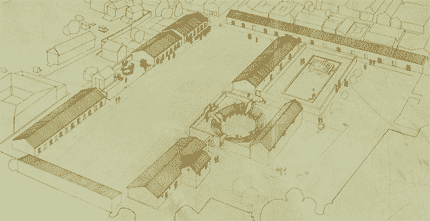
The Roman Forum of Paestum was the political, administrative, commercial and religious centre of the city during the Roman period.
Its development began after 273 BC, when Rome established a Latin colony at Paestum. The new public centre occupied part of the former Greek Agora, marking a major transformation in the organisation of the ancient city.
From the Greek Agora to the Roman Forum
After the establishment of the Roman colony, the public spaces of ancient Poseidonia were gradually adapted to the needs of the new city.
The Forum became the main public square of Roman Paestum, surrounded by buildings dedicated to politics, administration, justice, trade and religion.
This transformation did not take place all at once. The appearance and functions of the Forum changed repeatedly over the centuries as Roman Paestum developed.
Shops and commercial life
During the Republican period, numerous tabernae, or shops, stood around the square.
These small commercial spaces made the Forum one of the busiest areas of the city, where inhabitants could buy goods, conduct business and meet as part of everyday urban life.
On the southern side of the Forum stood the Macellum, a covered market primarily used for the sale of food.
The Forum was therefore not only an institutional centre but also one of the principal centres of economic activity in Roman Paestum.
The Comitium and political life
On the northern side of the Forum stood the Comitium, one of the most important political buildings in the Roman city.
It was used for assemblies of citizens and for activities connected with the political life of the colony, including the election of magistrates.
Other buildings around the square were connected with local government and administration, including the Curia, associated with the local senate and public archives.
Close to the Comitium stood a Republican-period temple traditionally known as the Temple of Peace. Its architecture combines different classical elements and represents one of the most interesting Roman religious buildings preserved at Paestum.
The Roman Basilica
On the southern side of the square stood the Basilica, a large public building used primarily for judicial and administrative activities.
Unlike the later Christian use of the word, a Roman basilica was not originally a religious building.
It was a large covered hall where legal proceedings, public meetings and other activities associated with the administration of the city could take place.
Its presence demonstrates the importance of the Forum as the institutional centre of Roman Paestum.
The Forum during the Imperial period
During the Roman Imperial period, the Forum underwent further transformations.
The rectangular square was surrounded by porticoes on all four sides, while some of the surrounding buildings acquired new functions connected with the political and religious life of the Empire.
The Forum continued to combine several roles within a single monumental area: government, justice, commerce and religion.
Sacred buildings also stood around the square, while the growing importance of the imperial cult influenced the use of some spaces within the centre of the city.
The Roman Forum today
Today, the remains of the Forum reveal a very different phase of Paestum's history from that represented by its famous Greek temples.
The traces of the large public square, shops, Comitium, Basilica, Macellum and religious buildings show how the city continued to develop after the establishment of Roman rule.
Walking through the Forum therefore makes it possible to see the transformation of Greek Poseidonia into Roman Paestum, with monuments from different periods and cultures preserved within the same archaeological landscape.