


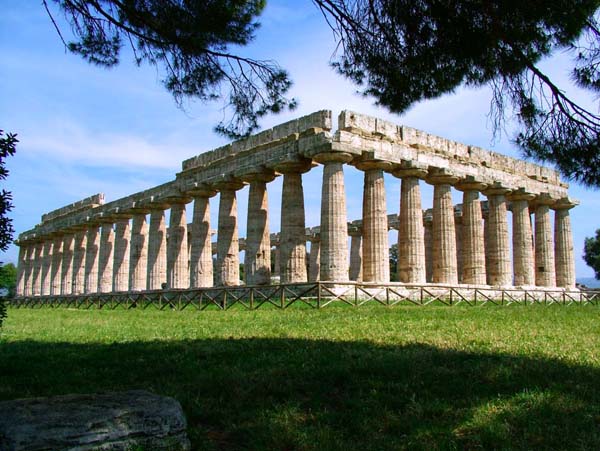
The Temple of Hera is the oldest of the three great Greek temples still standing at Paestum. It is located in the southern sanctuary of ancient Poseidonia, close to the monumental temple traditionally known as the Temple of Neptune.
Construction began around 560 BC and was completed around 520 BC, during a period of major development for the Greek city.
The Temple of Hera is one of the most important monuments in Paestum. A guided tour helps you better understand its architecture, religious function and the role the sanctuary played in the ancient city.
Discover the temples of Paestum on a guided tour
Why is it called the Basilica?
The Temple of Hera is also commonly known as the Basilica.
This name dates back to the 18th century, when early scholars studying the ruins did not yet understand the building's original function and believed it might have been a Roman civic building.
Later archaeological research established that it was in fact a Greek temple, almost certainly dedicated to Hera, one of the most important deities worshipped in ancient Poseidonia.
Architecture of the Temple of Hera
The temple is one of the most important surviving examples of Archaic Doric architecture in Magna Graecia.
The building is surrounded by a colonnade with nine Doric columns on the short sides and eighteen on the long sides. The columns have massive proportions and very flattened capitals, characteristics typical of the early development of the Doric order.
Inside the temple was the cella, the principal sacred chamber. In front of it stood the pronaos, or entrance porch, while at the rear was an enclosed chamber known as the adyton, probably connected with the religious functions of the sanctuary.
An altar stood in front of the eastern façade of the temple. As was usual in ancient Greek religion, sacrifices and many religious ceremonies took place outside the temple itself, around the altar.
The original decoration of the temple
The Temple of Hera did not originally have the uniform stone appearance that visitors see today.
Numerous archaeological finds have made it possible to reconstruct part of the original polychrome terracotta decoration of the roof.
These included decorated architectural elements, antefixes with lotus flowers and palmettes, and gutters ending in lion-head spouts.
The surviving fragments are an important reminder that Greek temples were originally richly decorated and coloured, rather than entirely white or monochrome as ancient architecture is sometimes imagined today.
The cult of Hera at Poseidonia
Hera, sister and wife of Zeus, played an important role in the religious life of Poseidonia.
The identification of the temple with the goddess is supported by inscriptions and numerous votive objects discovered in and around the sanctuary.
Hera was worshipped as a deity associated with marriage, motherhood and fertility, although her cult at Poseidonia also extended to other aspects of community life.
The importance of Hera in the region is demonstrated not only by this temple and the southern sanctuary of Poseidonia, but also by the great Sanctuary of Hera at the mouth of the River Sele, situated several kilometres north of the ancient city.
The Temple of Hera today
Although its roof, upper walls and much of its internal structure have disappeared, the monumental sequence of Doric columns still gives visitors a clear impression of the original scale and imposing appearance of the building.
The Temple of Hera is one of the most important monuments from the earliest monumental phase of Poseidonia and offers an exceptional opportunity to observe the characteristics of Archaic Greek Doric architecture in southern Italy.
Together with the Temple of Athena and the so-called Temple of Neptune, it forms part of the extraordinary group of Greek temples that has made Paestum one of the most important archaeological sites of Magna Graecia.