


The Sanctuary of Hera at the mouth of the Sele River, also known as the Heraion of the Sele, was one of the most important religious centres associated with ancient Poseidonia.
It lies around 9–10 kilometres north of Paestum, close to the River Sele, in an area that marked the northern boundary of the territory controlled by the Greek city.
Dedicated to Hera Argiva, the sanctuary was not only an important place of worship but also a symbolic landmark between the Greek territory of Poseidonia and the communities living north of the Sele.
The myth of Jason and Hera Argiva
According to an ancient tradition, the foundation of the sanctuary was connected with Jason, the legendary leader of the Argonauts.
During his return journey after obtaining the Golden Fleece, Jason was said to have founded a sanctuary near the mouth of the Sele dedicated to Hera, the goddess of Argos.
Beyond the mythological tradition, archaeological evidence shows that the sanctuary was established by Greek settlers during the 6th century BC, at the same time that Poseidonia was developing into an important city of Magna Graecia.
A sanctuary on the frontier of Poseidonia
The location of the Heraion was particularly significant.
The River Sele formed a natural boundary of the chora, the territory controlled by Poseidonia. To the north lay areas culturally connected with the Etruscan world, while the Greek-controlled territory extended south towards the city.
The sanctuary therefore stood in a frontier zone that was both a boundary and a place of contact and exchange between different cultures.
Its monumental presence also helped define the territory of Poseidonia far beyond the city walls.
The first temple and the Archaic metopes
Excavations revealed the remains of an early sacred building and an extraordinary group of sculpted sandstone metopes dating from the Archaic period.
The reliefs depict episodes from Greek mythology, including the Labours of Heracles and stories involving gods and heroes associated with the Trojan War.
The metopes originally formed part of the decoration of an early Doric temple and were intended to be completed with painted details.
They are among the most important surviving examples of Archaic Greek sculpture in Magna Graecia.
The original metopes are now preserved in the National Archaeological Museum of Paestum, whose earliest exhibition spaces were designed specifically to display these exceptional discoveries.
The great Temple of Hera
Around 500 BC, the earlier sacred building was replaced by a much larger monumental Doric temple.
The new temple was surrounded by eight columns on the short sides and seventeen on the long sides.
Two large altars stood in front of the building and were used during religious ceremonies and sacrifices.
Today, mainly the foundations of the temple survive at the archaeological site, while architectural elements recovered during excavations are preserved in the museum.
These finds include capitals, cornice fragments, lion-head waterspouts and another group of sculpted metopes depicting female figures.
The cult of Hera
Hera played a central role in the religious life of ancient Poseidonia.
The goddess was associated with youth, marriage, fertility and childbirth, but also with the protection of agriculture, livestock and the natural cycle of life.
Excavations at the sanctuary have uncovered thousands of votive offerings, including terracotta figurines, pottery, jewellery and objects made from bronze, bone, ivory and precious materials.
Hera is often represented seated on a throne and sometimes holds symbols such as a pomegranate, traditionally associated with fertility.
Evidence of ritual meals has also been discovered, including cooking vessels, serving dishes and animal bones.
The Square Building and female worship
The sanctuary continued to be used after Poseidonia came under Lucanian control.
Around 400 BC, a distinctive square building was constructed within the sanctuary.
Archaeologists found hundreds of terracotta loom weights inside it, together with pottery connected with marriage ceremonies and objects associated with domestic life.
These discoveries suggest that the building was used particularly by women devoted to Hera.
Young women preparing for marriage may have spent time there participating in rituals and activities such as weaving, perhaps producing textiles that were later offered to the goddess.
The discovery of the Heraion
The sanctuary remained hidden in the Sele plain for centuries.
Its modern rediscovery began during the 1930s, thanks to the work of archaeologists Paola Zancani Montuoro and Umberto Zanotti Bianco.
Their excavations uncovered the buildings of the sanctuary, thousands of votive objects and the celebrated cycle of Archaic metopes.
The discovery was so important that it contributed directly to the creation of the National Archaeological Museum of Paestum, which eventually opened in 1952.
The Narrating Museum of Hera Argiva
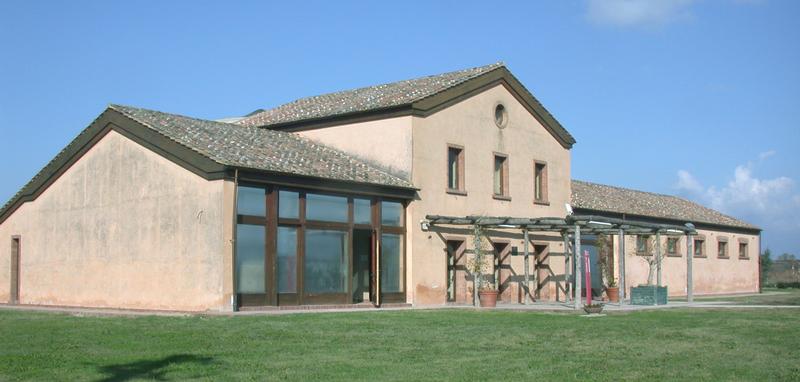
Close to the archaeological area stands Masseria Procuriali, a rural building dating from the 1930s that was later transformed into the Narrating Museum of Hera Argiva.
Opened in 2001, the museum was designed to explain the history of the sanctuary, its landscape and the rituals associated with the goddess through reconstructions and multimedia installations.
The museum and archaeological area have subsequently been involved in projects aimed at improving the presentation and accessibility of the Heraion.
Visiting the Sanctuary of Hera
The Sanctuary of Hera lies in the Foce Sele area, approximately 10 kilometres from the archaeological site of Paestum.
Today the site provides an opportunity to understand ancient Poseidonia beyond its city walls and famous temples.
The Heraion reveals the close relationship between the Greek city, its surrounding territory, the River Sele and one of the most important religious cults of Magna Graecia.
Because access arrangements and visiting times can change during the year, visitors should always check the latest information provided by the Archaeological Parks of Paestum and Velia before travelling to the sanctuary.