


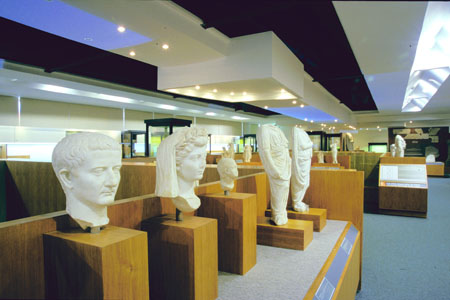
The National Archaeological Museum of Paestum is an essential part of any visit to the ancient city. Located beside the archaeological area, it houses objects discovered at Poseidonia-Paestum and in the surrounding territory, allowing visitors to understand the history behind the temples and monuments visible outside.
Founded in 1952, the museum has grown considerably over the decades. Its exhibition was completely renewed and expanded in 2023, creating a modern journey through the history of Paestum from its earliest origins to the Greek, Lucanian and Roman periods.
The Archaeological Museum completes your visit to ancient Paestum, preserving finds that help you better understand the history of the city and its inhabitants. To explore the temples and other monuments of the archaeological area in more depth, you can choose a guided tour with admission included.
Discover Paestum with an archaeologist guide
From Poseidonia to Roman Paestum
The museum collections illustrate the long history of the ancient city and its territory.
Pottery, sculptures, architectural decorations, inscriptions, weapons, coins and objects from everyday life help reconstruct the development of Poseidonia, founded by Greek settlers around 600 BC, its transformation under Lucanian rule and the establishment of the Roman colony of Paestum in 273 BC.
Many of these finds come directly from the archaeological area, while others were discovered in sanctuaries and necropolises surrounding the ancient city.
The museum therefore provides an important complement to a visit to the temples, Forum, houses and other monuments.
The metopes from the Sanctuary of Hera at the Sele
Among the most important works in the museum are the sculpted metopes from the Sanctuary of Hera at the mouth of the River Sele, several kilometres north of Paestum.
The sanctuary was one of the most important religious centres associated with ancient Poseidonia.
The Archaic metopes, dating mainly from the 6th century BC, depict episodes from Greek mythology. They originally formed part of the architectural decoration of sacred buildings within the sanctuary.
Their scenes include gods, heroes and mythical events and provide exceptional evidence of the development of Greek sculpture in Magna Graecia.
The Tomb of the Diver
The most famous object preserved in the museum is undoubtedly the Tomb of the Diver, discovered near Paestum in 1968.
Dating to around 480–470 BC, the tomb is exceptional for its painted decoration.
The four interior walls show scenes of a symposium, the aristocratic banquet that played an important role in Greek social life. Men recline on couches, drink wine, play music and converse.
The covering slab contains the image that has made the tomb famous throughout the world: a solitary young man diving from a stone platform into the water.
The meaning of the scene is still debated, but the dive is often interpreted as a symbolic passage from life to death.
The Tomb of the Diver is particularly important because large-scale Greek painting from the Classical period has survived only very rarely.
The painted Lucanian tombs
The museum also preserves an extraordinary collection of painted tombs from the Lucanian period, particularly from the 4th century BC.
Unlike the isolated Greek example of the Tomb of the Diver, painted funerary decoration became much more widespread during the Lucanian occupation of Paestum.
The scenes provide valuable information about the society, beliefs and customs of the city's inhabitants.
They depict funerary ceremonies, warriors returning from battle, armed combats, horsemen, chariot races and other aspects of aristocratic life.
The paintings also demonstrate the interaction between Greek artistic traditions and the culture of the Lucanian communities that controlled the city.
The sanctuaries and temples
Numerous objects displayed in the museum come from the sacred areas of ancient Poseidonia.
Architectural terracottas, fragments of painted decoration and votive offerings help reconstruct the original appearance of the temples and the religious ceremonies performed in their sanctuaries.
These objects also remind visitors that the Greek temples were originally much more colourful than they appear today.
The collections connected with the cult of Hera are especially important, reflecting the central role of the goddess in the religious life of Poseidonia.
Finds from the northern sanctuary also provide evidence for the worship of Athena, including votive objects associated with the goddess.
Everyday life in the ancient city
Not all the objects in the museum belonged to temples or wealthy tombs.
Archaeological excavations have also uncovered pottery, tools, coins and household objects that reveal aspects of everyday life in the city.
Together, these objects help reconstruct how people lived, worked, traded and worshipped over many centuries.
They show that Paestum was not simply a city of monumental temples, but a living urban community that continuously changed as different cultures occupied the site.
Why visit the museum?
The archaeological area and the museum are best understood as two parts of the same visit.
Outside, the temples, streets, Forum, Amphitheatre and houses reveal the monumental structure of the ancient city. Inside the museum, the objects discovered during excavations help explain who built those monuments, how they were decorated and how the inhabitants of Poseidonia and Paestum lived.
Above all, the Tomb of the Diver, the painted Lucanian tombs and the metopes from the Heraion at the Sele make the museum one of the most important archaeological collections devoted to Magna Graecia in southern Italy.