


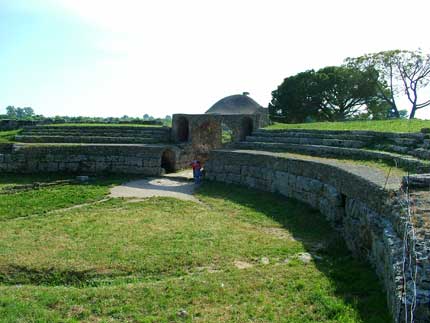
The Amphitheatre of Paestum is one of the most important monuments of the Roman city. It stands just north-east of the Forum and provides valuable evidence of the transformation of ancient Poseidonia after the establishment of Roman rule.
The first phase of the building probably dates to the middle of the 1st century BC, around 50 BC, making it an early example of a monumental Roman amphitheatre.
The building was used for public entertainment, particularly gladiatorial combats and other spectacles held in the arena.
One of the earliest Roman amphitheatres
The construction of the amphitheatre reflects the gradual transformation of Paestum after Rome founded a Latin colony here in 273 BC.
Over the following centuries, the city increasingly acquired the political, social and monumental features typical of a Roman urban centre.
Alongside the Forum, baths and other public buildings, the amphitheatre provided a permanent venue where large numbers of inhabitants could gather for public spectacles.
The earliest structure was simpler than the monument visible today and did not yet include the large external ring added during a later phase.
The arena and the cavea
At the centre of the amphitheatre was the arena, the space in which the spectacles took place.
Around it rose the cavea, the seating area reserved for spectators. A high barrier separated the audience from the arena and provided protection during the performances.
This was particularly important during spectacles involving animals.
As in other Roman amphitheatres, the arrangement of the seating also reflected the social organisation of the community, with different sectors reserved for different groups of spectators.
The enlargement of the amphitheatre
The building was modified several times during its history.
One of the most important transformations took place during the 1st century AD, when a new external ring was constructed using pillars and brick structures.
This enlargement increased the capacity of the amphitheatre and created additional space for spectators.
Above the outer structures rose the upper part of the cavea, which may have included elements constructed partly from wood.
The different building techniques still visible today make it possible to recognise several phases in the development of the monument.
Public spectacles in Roman Paestum
Public entertainment played an important role in the social life of Roman cities.
Among the most popular events held in amphitheatres were gladiatorial combats and spectacles involving animals.
Traditions connected with ritual combat, however, had much older roots in the region around Paestum. Some painted tombs from the Lucanian period depict scenes of duels and fighting dating from centuries before the construction of the Roman amphitheatre.
Under Roman rule, these forms of entertainment became organised spectacles held in a monumental building designed to accommodate large crowds.
Why is only part of the amphitheatre visible today?
One of the most noticeable features of the Amphitheatre of Paestum is that only part of the monument can be seen today.
A substantial section of the ancient building still lies beneath the modern road that crosses this part of the archaeological area.
The construction of the road prevented the complete excavation of the amphitheatre and makes it difficult for visitors to appreciate its original size and complete elliptical plan.
The surviving remains nevertheless allow the arena, seating areas, entrances and several phases of the monumental structure to be clearly recognised.
The Amphitheatre of Paestum today
Although less famous than the great Greek temples, the amphitheatre is an essential monument for understanding Roman Paestum.
It demonstrates how the ancient Greek city of Poseidonia continued to evolve for centuries after the Roman conquest, acquiring new buildings dedicated to government, commerce, everyday life and entertainment.
Together with the Roman Forum and residential districts, the amphitheatre reveals an important side of Paestum's history: this was not only a great Greek city, but also a thriving Roman community with its own public spaces and traditions.